

Views: 0 Author: Site Editor Publish Time: 2026-10-06 Origin: Site


To solve dimensional instability, factory engineers must first understand the physics driving it. By breaking down the specific types of shrinkage, operators can apply the correct mechanical countermeasures on the finishing line.
Think of a yarn as a stretched rubber band. During the manufacturing process, yarns are pulled tightly on looms and knitting machines to maintain high production speeds. This constant pulling forces the fibers into an elongated and unnatural state. When the final garment is washed by a consumer, the warm water and mechanical agitation act as a release mechanism. The fibers finally relax and snap back to their original unstretched state. This remains the most prevalent cause of dimensional loss.
Swelling shrinkage primarily affects natural hydrophilic fibers. When these materials absorb water during a heavy wash cycle, the individual threads physically swell in diameter. As the yarns become thicker, they require more spatial room. To accommodate this increased width, the yarns pull closer together. Consequently, this reduces the overall length and width of the fabric panel.
Felting shrinkage is a unique phenomenon occurring almost exclusively in animal fibers like wool. Under a microscope, wool fibers are covered in tiny overlapping scales. When exposed to a combination of heat, moisture, and the friction of a washing machine agitator, these scales open up and interlock. This creates a dense and permanently matted structure.
In contrast to natural fibers reacting to water, synthetic fibers react violently to heat. Materials made from synthetic polymers are thermoplastic. If these fabrics are not properly heat-set at the factory level, exposing them to the high heat of a consumer tumble dryer will cause the internal polymer chains to contract. This results in severe thermal shrinkage and alters the garment fit entirely.
Fabric does not naturally want to shrink. The tendency to contract is artificially introduced during its stressful journey through the textile mill. Understanding where this tension is applied is critical for quality control managers.
Picture the factory floor. Raw fibers are twisted violently during spinning. Later, weaving looms yank warp yarns with immense continuous strain to allow weft threads to interlace at breakneck speeds. Similarly, circular knitting machines pull yarns tightly over needles to form tiny loops. This continuous mechanical stress locks the fabric into a stretched state long before it reaches the finishing department.
Furthermore, wet processing often exacerbates the tension introduced during weaving. Running fabrics through continuous boiling dye baths and washing machines usually involves pulling the heavy wet fabric roll over dozens of guide rollers. This longitudinal pulling elongates the pliable fabric even further. If this tension is not deliberately counteracted during the final drying stages, the fabric is guaranteed to suffer from severe shrinkage.
Not all fabrics behave the same way under stress. A facility finishing line must be meticulously calibrated according to the fiber composition of the current batch.
Cotton, rayon, and other cellulosic fibers carry a high risk for both swelling and relaxation shrinkage. Because they easily absorb water and lose their shape, they require aggressive mechanical compaction. The finishing process must force the warp yarns to compress together tightly before the fabric is rolled and cut.
Synthetics have a very low moisture regain. This means they do not swell significantly in water. However, they have a massive risk of thermal shrinkage. Finishing synthetics requires precise temperature control, often between 150 and 200 degrees Celsius, to temporarily melt and realign the internal polymer chains. This locks the fabric dimensions into place.
Blends present a complex challenge because they exhibit the vulnerabilities of both natural and synthetic materials. Finishing a poly-cotton blend typically requires a rigorous two-step approach. First, high-temperature heat-setting stabilizes the polyester. Immediately after, mechanical compaction addresses the cotton relaxation shrinkage.
| Fiber Type | Primary Shrinkage Risk | Moisture Absorption | Required Finishing Solution |
|---|---|---|---|
| 100% Cotton | Relaxation & Swelling | High | Heavy Mechanical Compaction |
| 100% Polyester | Thermal Shrinkage | Low | High-Temperature Heat Setting |
| Wool | Felting Shrinkage | High | Anti-felting treatments & gentle finishing |
| Poly-Cotton Blends | Combined Risk | Medium | Heat Setting + Mechanical Compaction |
For B2B textile manufacturers, dimensional instability is not just a technical error. It is a critical financial liability. Failing to control shrinkage directly impacts the bottom line and destroys brand reputation.
Recent industry analyses reveal a significant shift in how mills approach dimensional stability. Global regulatory bodies are tightening restrictions on formaldehyde-based resins. Meanwhile, consumers increasingly demand eco-friendly apparel with verified safety certifications. Consequently, chemical shrinkage control is rapidly phasing out. In addition, the market pivot from fast fashion to durable slow fashion means garments are expected to withstand dozens of aggressive wash cycles without structural distortion.
When residual shrinkage is left unchecked, the immediate result is garment distortion. Seams pucker, hemlines twist, and the structural integrity of the apparel is compromised. Brands will swiftly reject entire batches of fabric. This leads to massive financial losses for the mill, chargebacks, and severed business contracts. Therefore, B2B brands now mandate rigorous mechanical compaction as a non-negotiable baseline in their vendor contracts. Manufacturers are forced to modernize their finishing lines or risk obsolescence.
Achieving zero-defect dimensional stability relies entirely on routing the fabric through advanced mechanical finishing lines. These machines manipulate heat, moisture, and mechanical pressure to permanently control fabric dimensions.
The stenter is arguably the most critical piece of equipment in a modern textile finishing facility. Its primary function is to dry textiles, control the fabric width, and perform thermal heat-setting. The machine operates by securely gripping the edges of the fabric with continuous chains of pins or clips. As the fabric is transported through a series of long heated chambers, the machine utilizes a crucial technique called overfeeding. Overfeeding means the feed rollers push more fabric onto the pins at a speed slightly faster than the take-up rollers pull it away at the exit. This intentional slack allows the warp yarns to relax and naturally contract under the heat. Mill operators must understand exactly how to control fabric width and shrinkage with a Stenter Machine. High-end models feature precise temperature accuracy within 1 degree Celsius and uniform airflow distribution, which permanently locks in the molecular structure of synthetic blends and neutralizes future thermal shrinkage risks.
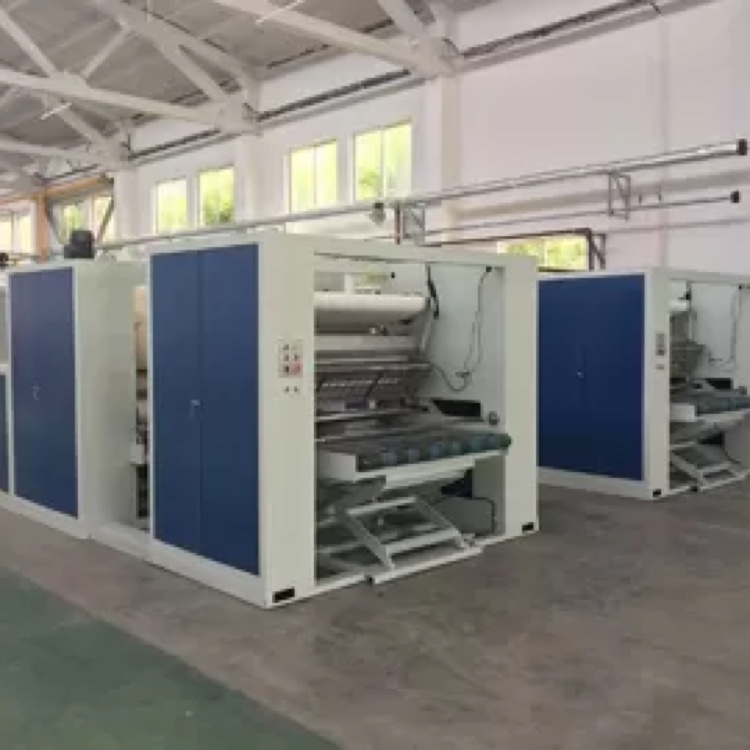
While a stenter is exceptional for heat-setting synthetics, cellulosic fibers and open-width knits require aggressive mechanical compression to mitigate relaxation shrinkage. This is where the compactor becomes indispensable. This machine uses a sophisticated combination of steam, heated cylinders, and a specialized compression mechanism. Specifically, advanced models utilize a 20mm thick Nomex endless felt blanket pressing against a thermal oil heated cylinder. Operators visually inspect the steam permeation as it acts as a plasticizer to swell the cotton fibers and make the yarns pliable. Because the feeding mechanism operates at a higher speed than the exit mechanism, the fabric is physically forced to bunch together at a microscopic level. When evaluating the applications of open-width compactor machines in woven fabric finishing, their primary value lies in drastically reducing residual shrinkage to under 3 percent without the need for stiffening chemicals.
Not all fabrics can be processed flat. Seamless garments, like the bodies of standard t-shirts, are knitted in continuous tubes. Slitting them open for an open-width machine would ruin the seamless design. The Tubular Compactor is engineered specifically for this format. Before entering the compaction zone, the tubular fabric is guided over an internal magnetic stretcher. This frame gently expands the tube from the inside to the exact required width without applying excessive longitudinal tension. Steam is injected to relax the fibers. The tube is then passed through dual-stage compaction rollers. Utilizing a high-precision low shrinkage compactor machine ensures the knitted loops are compressed and stabilized uniformly on both the front and back layers. This prevents the twisting and shrinking commonly associated with low-quality tubular apparel.
Implementing advanced machinery is only half the battle. Manufacturers must empirically validate that their finishing process was successful before the fabric is shipped. The global textile industry relies on standardized testing methodologies, most notably AATCC Test Method 135 and ISO 6330.
The best practice involves taking a sample from the finished fabric roll, conditioning it in a climate-controlled room, and marking precise bench marks on the warp and weft axes. The sample is then subjected to standardized washing and tumble-drying cycles that mimic aggressive consumer laundering. After re-conditioning, the marked distances are re-measured. In professional B2B textile manufacturing, acceptable residual shrinkage rates are strictly defined. Tightly woven fabrics must typically remain under 3 percent shrinkage. Knitted fabrics must stay under 5 percent shrinkage. Failing these tests indicates that the stenter overfeed or compactor steam pressure must be immediately recalibrated.
Fabric shrinkage after finishing is a natural physical reaction to the immense tension applied during the manufacturing process. Left unchecked, this dimensional instability ruins garments and destroys B2B relationships. However, this issue is entirely preventable. Relying on outdated chemical finishes is no longer a viable or eco-friendly option.
To survive in today's quality-driven market, you must invest in high-precision mechanical finishing equipment. By physically forcing the fabric to relax and contract in a controlled factory environment, manufacturers can ensure that the final garment remains perfectly stable.
Upgrade your textile finishing lines today. Equip your factory floor with advanced textile finishing machinery from industry leaders like Virock. Explore high-efficiency Stenters and Open-Width Compactors to permanently optimize your shrinkage control process, secure buyer trust, and eliminate costly batch rejections.
An acceptable percentage depends heavily on the structural geometry of the fabric and the specific requirements of the apparel brand. Generally, empirical industry standards dictate that woven fabrics should exhibit a residual shrinkage of 1 to 3 percent. Woven materials have tightly interlaced yarns that naturally restrict excessive movement. Conversely, knitted fabrics possess a looped structure that is inherently more flexible and prone to relaxation. Therefore, a higher tolerance of 3 to 5 percent is standard for most commercial knits. High-stretch activewear may occasionally have tolerances up to 6 percent, provided this is agreed upon in the manufacturing specifications.
From a consumer standpoint, permanent reversal of shrinkage is highly improbable. If a garment shrinks in a home washing machine, the fibers have reverted to their unstretched state. While consumers can sometimes temporarily stretch a garment back to its original shape while wet, this is not a permanent structural fix. The garment will likely shrink again during the next wash cycle. True permanent dimensional stability must be engineered at the factory level through mechanical compaction before the fabric is ever cut and sewn.
Overfeeding is a critical mechanical adjustment used to counteract the longitudinal tension applied during earlier wet processing stages. In a stenter, the input rollers are calibrated to feed the fabric onto the holding pins at a velocity greater than the speed at which the fabric is pulled through the machine. This intentional discrepancy creates slack in the lengthwise yarns. As the fabric travels through the high-temperature heating chambers, this slack allows the yarns to physically retract and relax without being pulled taut. This effectively eliminates the potential for future relaxation shrinkage.
The primary difference lies in the physical presentation of the fabric they are designed to process. An open-width compactor is engineered for flat fabrics. This includes all woven textiles and knitted fabrics that have been slit open at the edges. It utilizes a wide flat entry system and compresses the fabric against a heated cylinder using a heavy felt blanket or Teflon shoe. A tubular compactor is specifically designed for fabric knitted in a continuous seamless tube. It employs an internal magnetic stretcher to hold the tube open from the inside. This ensures the fabric is compacted uniformly on both the front and back layers without creating permanent creases at the folded edges.
The tumbling action and intense heat of a dryer create the perfect storm for dimensional loss. While the washing machine introduces moisture to swell the fibers, the dryer applies mechanical agitation and high temperatures. For synthetic materials, this heat causes internal polymer chains to contract rapidly. For natural fibers, the tumbling friction forces the swollen yarns to compress and mat together tightly. Drying fabrics flat or on a line removes this mechanical friction, significantly reducing the shrinkage rate.
Washing in cold water significantly reduces the risk of shrinkage, but it does not eliminate it entirely. Cold water prevents the excessive swelling of natural fibers and keeps synthetic polymers below their thermal contraction threshold. However, if the fabric was subjected to extreme mechanical tension during manufacturing and was never properly pre-shrunk using an industrial compactor, the mechanical agitation of the washing machine alone can still cause the yarns to relax and shrink.


