

Views: 0 Author: Site Editor Publish Time: 2026-10-04 Origin: Site


Every textile mill manager knows the exact feeling. You stand on the factory floor. You hold a freshly cut swatch from a newly finished batch. You place it on the digital scale. Suddenly, the fabric weight is completely off. A batch engineered for lightweight summer apparel feels thick and heavy. Alternatively, a robust winter fleece feels flimsy and cheap.
A fabric weight shift after thermal processing causes major production headaches. It leads to delayed shipments and rejected lots. However, this fluctuation is not a manufacturing defect. It is a highly predictable physical and chemical reaction. When textiles enter a high-temperature environment, their molecular structure and physical geometry undergo fundamental alterations.
In this engineering guide, we will break down the exact scientific mechanics behind these weight fluctuations. We will explore practical, floor-level strategies to control this phenomenon. Implementing these methods ensures every roll of fabric you produce meets strict buyer specifications.
Grams per Square Meter serves as the standard metric worldwide to measure the physical weight and density of a fabric. It acts as the foundational specification in textile manufacturing. This number directly influences the functional properties, drape, and commercial value of the material.
To fully grasp its importance on the production floor, one must first establish what is GSM in textile manufacturing and how it dictates both quality and cost. A higher density typically indicates a thicker, more robust fabric. This requires more raw yarn and chemical add-ons. It inherently drives up your production costs. Conversely, a lower density yields a lighter, highly breathable fabric suited for activewear collections. Buyers specify exact weight targets to ensure the fabric performs perfectly for its intended end-use.
Global apparel markets are shifting rapidly. Industry data shows a massive consumer demand for ultra-lightweight, high-performance activewear. This trend places unprecedented pressure on dye houses and finishing facilities. A decade ago, brands might accept a loose ten percent weight variance. Today, performance brands demand strict three percent tolerances. Mastering thermal dynamics is no longer just an operational goal. It is a survival imperative for modern textile mills.
Furthermore, the raw greige fabric weight is merely a starting baseline. Throughout the dyeing, washing, and finishing stages, the fabric undergoes severe mechanical and thermal stress. Professional textile engineers must mathematically anticipate these shifts. The raw fabric weight is rarely the finished weight.
Understanding the actual science requires a brief dive into polymer physics. A fabric weight shift after thermal processing is driven by three primary interconnected factors. These are thermal contraction, moisture management, and mechanical relaxation.
The primary driver of weight alteration is thermal shrinkage. When synthetic fibers are exposed to intense heat, their polymer chains agitate. They attempt to return to a relaxed, coiled state. This causes the individual fibers to contract physically. As the fabric shrinks in length and width, the exact same amount of yarn mass compresses into a significantly smaller surface area. This physical compaction naturally increases the density. It results in a higher reading on your digital scale.
Thermal processing is simultaneously a rapid drying stage and a chemical curing stage. As the wet fabric passes through the heating chambers, residual water weight evaporates entirely. This temporarily lowers the physical weight of the material. However, this loss is almost always offset by the application of finishing chemicals. Softeners, anti-pilling agents, stiffening resins, and specialized waterproof coatings add solid mass back into the fiber matrix. The net mathematical difference between the evaporated water and the cured chemical solids directly impacts the final weight.
Knitting and weaving are inherently high-tension processes. Yarns are pulled taut by needles and looms to form the fabric structure. This stores immense mechanical stress within the interlacements. High temperatures act as a catalyst to release this trapped energy. As the tension relaxes, the elongated loops become rounder and tighter. This stress relaxation causes dimensional shrinkage. It means more yarns are packed into every square meter. It elevates the fabric's overall weight.
Not all fabrics behave the same way inside an oven. The chemical makeup of the yarn dictates whether the material will become heavier, lighter, or remain stable after finishing.
| Fabric Type | Thermal Reaction | Primary Density Driver | Typical Weight Shift |
|---|---|---|---|
| 100% Polyester | High thermoplastic shrinkage | Polymer chain contraction | Significant Increase |
| Poly-Cotton Blends | Matrix compaction | Polyester pulling cotton fibers | Moderate to High Increase |
| 100% Cotton | No thermal memory | Mechanical tension and moisture | Slight Decrease or Stable |
| Spandex Blends | Extreme heat sensitivity | Elastane contraction | High Increase if not pre-set |
A common observation in textile mills is that a polyester-cotton blend often exhibits a significantly higher finished weight than its raw grey fabric state. This occurs specifically because polyester is a thermoplastic fiber. When heated past its glass transition temperature, polyester becomes highly pliable and shrinks considerably. Once cooled, it locks into this new, denser structure. This concept is known as thermal memory. Cotton, while less affected by heat, is forcefully pulled along by the shrinking polyester matrix. The combined contraction results in a heavily compacted fabric structure. It drives the weight upward.
In contrast, 100% cotton and other pure natural fibers lack thermoplastic properties. They do not possess thermal memory and will not shrink solely due to heat exposure. Instead, cotton's weight changes are primarily driven by moisture management and mechanical compaction. Cotton swells when wet and shrinks when dried mechanically. Therefore, the weight shift in pure natural fibers is generally less drastic than in synthetics. It relies heavily on the mechanical tension applied by the rollers rather than molecular contraction.
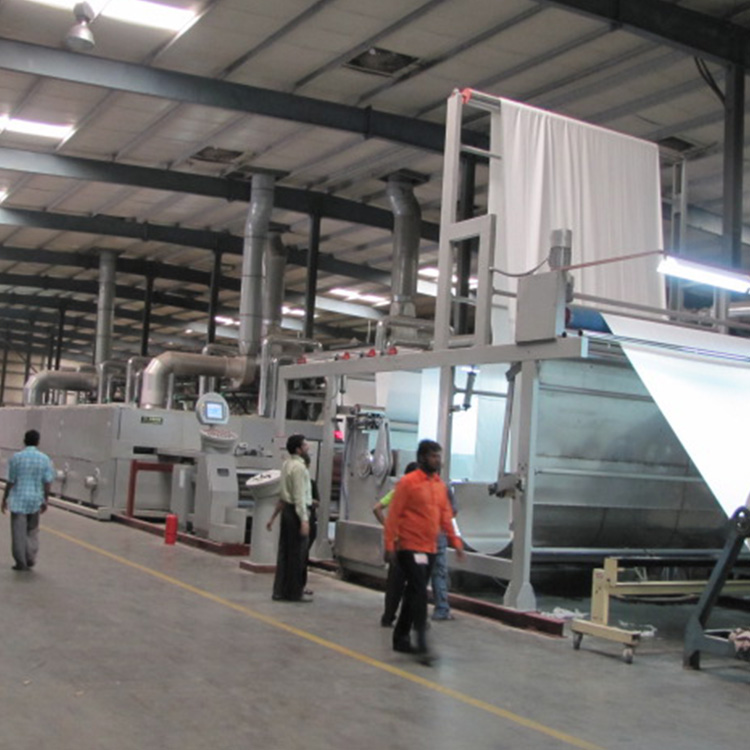
To achieve the precise specifications demanded by global brands, operators must strategically control fabric width and shrinkage with a Stenter Machine. This sprawling piece of equipment serves as the central nervous system of the finishing department.
The overfeed mechanism is arguably the most critical variable in density manipulation. Overfeeding occurs when the entry feed rollers push more fabric into the machine than the physical running speed of the pin chains. For example, dialing in a plus five percent overfeed means 105 meters of fabric are fed into a 100-meter section of the machine. This intentional slack allows the fabric to shrink longitudinally as it travels through the baking chambers. By permitting this controlled lengthwise shrinkage, the yarns compact beautifully. It effectively increases the final weight.
Simultaneously, the width of the machine can be adjusted mechanically across its various heating zones. If the operator widens the tenter frames, the fabric is stretched horizontally. Stretching the fabric increases its total surface area. This spreads the yarn mass out and decreases the density. Conversely, allowing the frames to taper slightly inwards permits width-wise shrinkage. It packs the yarns closer together and increases the density. Balancing the vertical overfeed and the horizontal width tension is the mathematical key to hitting exact targets.
Finishing lines utilize either pins or clips to hold the fabric selvedges during transport. Pin systems physically pierce the fabric edges. They allow for excellent overfeed control and natural shrinkage. This makes them ideal for knits where weight increases are often required. Clip systems hold the fabric firmly without piercing. This setup is generally preferred for woven fabrics that require high tension and strict width maintenance. It often results in a more stable or slightly lower density.
Beyond mechanical tension, the thermodynamic settings on a Heat Setting Machine dictate how the polymer structure of the fabric cures. Operators are essentially manipulating molecular chemistry in real-time.
The relationship between temperature and dwell time is paramount. For synthetic fibers, operators must find the precise temperature threshold. This typically hovers between 180 and 210 degrees Celsius. If the temperature is too low or the machine runs too fast, the fabric will not achieve thermal stability. It leads to unpredictable weight shifts later on. If the temperature is too high, the fibers can over-shrink, become brittle, or even melt. It ruins the batch and causes an excessively high, uncontrolled density.
Inside the chambers, hot air is violently circulated via blowers. The velocity of this airflow impacts the drying rate and the physical agitation of the textile. Aggressive fan speeds can cause the fabric to billow and flap. It alters the surface texture and causes uneven shrinkage. Controlled, uniform airflow ensures that moisture evaporates consistently across the entire width of the fabric web. It prevents localized variations where the center of the roll weighs differently than the edges.
The final, often overlooked step is the cooling zone. After the fabric is heated and its molecular structure is realigned, it must be rapidly cooled before it exits the machine. This sudden drop in temperature locks in the new structural dimensions and the resulting weight. If the fabric is rolled onto an A-frame while still hot, the residual heat combined with the tension of the winding process will cause further stretching. It inadvertently lowers the weight and causes permanent structural deformation.
In modern commercial textile manufacturing, the margin for error is exceptionally narrow. Relying on outdated equipment introduces unacceptable variables into the production line.
Using older machinery often results in poor temperature regulation and uneven tension control. This leads to a phenomenon known as density banding. Different sections of the exact same fabric roll exhibit wildly varying weights. A batch that fluctuates by more than five percent from the target specification will likely fail independent quality control testing. This results in wasted raw materials, lost energy, and severe financial chargebacks from the buyer.
Investing in a state-of-the-art Fabric Finishing Machine provides operators with granular, digital control over the entire process. Modern lines feature automated tension sensors. They utilize digital temperature monitoring with closed-loop feedback. They offer highly precise overfeed dials. High-quality systems employ 150-millimeter thick insulation panels to guarantee exceptional thermal stability and combined heating efficiency. These automated Programmable Logic Controllers detect micro-variations in fabric tension. They adjust the machine speed or width in milliseconds. It ensures a perfectly uniform weight from the first meter to the last.
While the initial capital expenditure for advanced finishing equipment is significant, the return on investment is realized rapidly. Better machines optimize energy consumption by precisely controlling exhaust air and heating efficiency. They also reduce chemical waste through uniform padding application systems. Most importantly, the ability to empirically guarantee that the finished product perfectly matches the buyer's spec sheet elevates a manufacturer's reputation. It secures lucrative long-term contracts.
The technical processes executed on the factory floor have a direct and profound impact on the consumer's daily experience with the final garment.
The finished density dictates the physical properties and tactile feel of the apparel. A higher density, achieved through proper thermal processing and compaction, yields a denser, warmer, and more durable garment. This is essential for products like heavy winter hoodies, protective workwear, or upholstery. Conversely, a lower density is engineered for breathability, moisture-wicking, and drape. If the factory fails to control the weight, a heavy winter garment may end up feeling cheap and flimsy. A delicate summer shirt may feel uncomfortably stiff and restrictive.
Perhaps the most critical reason to meticulously control fabric weight alteration is to ensure dimensional stability. If the fabric is not properly stabilized at the factory, residual stress remains trapped in the yarns. When the consumer eventually washes the garment in warm water or exposes it to the heat of a tumble dryer, that trapped stress is finally released. This results in severe post-purchase shrinkage, warping, or structural degradation. Proper finishing provides the fabric with permanent thermal memory. It ensures it maintains its shape, size, and weight throughout its lifecycle.
To achieve repeatable success and eliminate guesswork, textile engineers must implement rigorous standard operating procedures within the finishing department.
Manufacturers must strategically decide whether to heat set the fabric before dyeing or after dyeing. Pre-setting is often utilized for synthetic blends containing spandex to lock in the width. It prevents permanent crease marks during the high-pressure dyeing process. However, pre-setting alters the dye uptake and establishes a baseline weight. Post-setting is then used to finalize the weight and apply chemical finishes. Understanding the cumulative effect of both thermal processes is essential for accurate weight forecasting.
Theoretical calculations must always be validated by empirical data. Operators should not wait until the roll is finished to check the weight. Best practice dictates regularly cutting swatches from the production line mid-run. Utilize calibrated circular cutters and digital scales. Testing should occur at multiple stages. Check the raw grey fabric, post-dyeing, and immediately post-finishing. This real-time auditing allows operators to make micro-adjustments to the overfeed or temperature before an entire batch is processed out of spec.
Because every fabric blend reacts differently to thermal tension, operators cannot rely on universal machine settings. Facilities should develop a digital library of machine recipes logged into the equipment's computerized control system. These logs should detail the exact temperature, machine speed, blower intensity, and overfeed percentage for specific fabric types. For example, Recipe 42 for a polyester-cotton fleece target of 280 grams per square meter. Standardization eliminates manual operator errors and ensures batch-to-batch consistency across different production shifts.
A fabric weight shift after thermal processing is an unavoidable physical reality. It is one that can be fully manipulated and perfected with the right knowledge and equipment. By understanding how thermal shrinkage, moisture loss, and yarn tension interact, production managers can predict weight shifts rather than react to them.
Balancing temperature, mechanical tension, and chemical applications is an art supported by the rigorous science of modern machinery. If your facility is consistently struggling with unpredictable weight variations, evaluating your current finishing line is a crucial next step. Upgrading to advanced, automated equipment, such as the high-insulation stenter finishing machines offered by Virock Machines, ensures that you can meet strict buyer specifications effortlessly. It reduces waste, optimizes your energy consumption, and protects the final consumer's experience. Explore the full range of precision fabric finishing machines at Virock Machines to secure your production consistency today.
Yes, it is entirely normal and expected. As the fabric is exposed to high thermal energy in the heating chambers, the synthetic polymers contract. This causes the yarns to shrink and compact closer together. Furthermore, the finishing process often involves the application of chemical agents such as softeners or resins. These add physical mass to the textile. This usually results in a higher finished weight compared to the raw grey fabric state.
This machine controls weight primarily through its overfeed mechanism and width adjustment frames. By adjusting the overfeed, operators can feed more fabric into the machine than the speed at which it is pulled through. This allows the fabric to compress vertically. Simultaneously, stretching the fabric wider horizontally will decrease the density, while allowing it to narrow will increase the density and weight.
Absolutely. The physical performance of a textile is heavily dependent on its density. For example, a specific polyester-cotton blend finished at a low density will be highly breathable, lightweight, and drape easily. This makes it ideal for summer wear. That exact same yarn blend, if compacted and finished at a high density, will be significantly stiffer, warmer, and more resistant to abrasion. This makes it suitable for outerwear.
Exceeding the optimal temperature threshold for a specific fiber type has catastrophic effects on the batch. For synthetic fibers, excessive heat can cause the polymers to melt, become brittle, or undergo thermal yellowing. Structurally, it induces excessive and uncontrollable shrinkage. It leads to a finished weight that is far heavier than the buyer’s specifications. It renders the material unusable for its intended garment pattern.
Preventing post-purchase shrinkage relies entirely on the factory's finishing process. The fabric must undergo proper dimensional stabilization on a high-quality finishing line. Proper processing imparts thermal memory to the internal structure of the fibers. Once the fabric is set at a high temperature and rapidly cooled, it will not shrink further when exposed to the much lower thermal energy of a standard home washing machine or tumble dryer.
Historically, an allowance of plus or minus ten percent was common in standard apparel. Today, the industry has shifted. High-performance activewear brands and premium labels demand a much stricter tolerance. Many modern contracts require a maximum variation of plus or minus three to five percent. Failing to meet this tight window often results in rejected shipments and financial penalties.
Yes. High temperatures can cause dye sublimation or thermal yellowing, especially in synthetic blends. When the fabric enters the high-heat chambers, certain dye molecules can migrate or break down. Operators and dye masters must anticipate this thermal shift. They adjust their original dye formulations to account for the heat exposure, ensuring the final, cooled fabric matches the client's exact color standard.


