

Views: 0 Author: Site Editor Publish Time: 2026-10-10 Origin: Site


Picture a bustling cutting room floor where hundreds of yards of freshly dyed cotton are unrolled. Suddenly, the automated laser cutter halts. The grain line is wildly distorted. The entire batch is now unusable. Are you losing money to these types of rejected, misshapen fabric batches?
Understanding fabric bowing and skewing solves this frustrating and costly problem. Maintaining strict dimensional stability is critical in both woven and knitted textiles. In this comprehensive engineering guide, we will dive deep into the exact mechanical root causes of these defects. Beyond diagnosing the issue, we will explore permanent fixes using advanced textile finishing machinery.
Recently, the global textile industry has seen a massive shift toward AI-driven automated cutting rooms. These high-speed production systems demand near-zero tolerance for grain line distortion. Furthermore, rising global energy costs make reprocessing rejected batches financially crippling. Modern mills can no longer afford to treat fabric distortion as a minor cosmetic issue. It is a critical operational failure requiring immediate mechanical intervention and upgraded tension control systems.
Maintaining strict dimensional stability is a primary objective in modern textile manufacturing. When fabric comes off a loom or knitting machine, the vertical warp yarns and horizontal weft yarns must intersect at a perfect 90-degree angle. Whenever this perpendicular relationship is compromised, fabric distortion occurs. To implement effective quality control on the factory floor, engineers must first clearly distinguish between the two primary types of structural distortion.
Fabric bowing is a condition where the weft yarns are straight and properly aligned at both selvedge edges of the fabric but curve forward or backward in the center. Visually, the distorted weft yarn resembles the shape of an archer’s drawn bow.
This defect typically presents in two forms. A leading bow occurs when the center of the weft yarn moves ahead of the edges during wet processing. In contrast, a trailing bow happens when the center of the weft yarn lags behind the edges. Ultimately, this structural defect indicates that the center of the fabric web is experiencing a different rate of travel or tension compared to the outer edges.
Fabric skewing, frequently referred to as biasing, occurs when the weft yarns remain perfectly straight but run at an angular slant. Instead of crossing the warp yarns at a right angle, the weft yarns are pulled diagonally. In practical terms, one side of the fabric is effectively running ahead of the opposite side. This drags the entire horizontal structure out of square.
| Defect Type | Visual Appearance | Primary Mechanical Cause | Required Machine Correction |
|---|---|---|---|
| Bowing | Center curves forward or backward (arch shape). | Uneven pressure on nip rollers; center tension lag. | Curved banana rollers on a straightener. |
| Skewing | Straight but slanted diagonally across the width. | Misaligned guide rollers; asymmetrical pulling force. | Diagonal pivoting rollers on a straightener. |
While bowing and skewing are mechanically distinct issues, they frequently manifest simultaneously on the exact same fabric roll. This phenomenon is tied to the continuous nature of modern textile wet processing. A fabric web traveling through washing, dyeing, and drying ranges at high speeds is subjected to multiple, simultaneous mechanical forces. For instance, a misaligned guide roller might pull one edge faster to cause a skew. Simultaneously, high surface friction in the center of a downstream nip roller holds the middle back, inducing a bow.
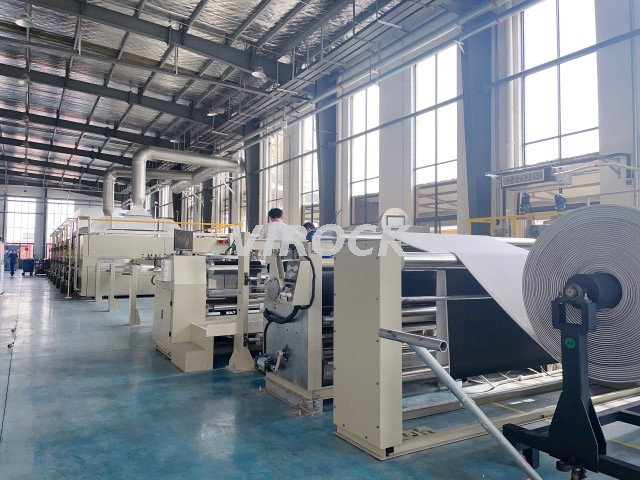
Understanding what triggers these defects requires a deep dive into the physical forces applied during textile processing. These distortions are rarely caused by a single isolated event. Rather, they are the cumulative result of continuous mechanical stress, degraded machine conditions, and inherent yarn properties.
The most common culprit behind structural fabric distortion is uneven longitudinal tension. In continuous processing lines, textiles pass through multiple padding mangles, washing boxes, and drying chambers. If the tension across the width of the fabric is not perfectly uniform, distortion is inevitable. When a fabric is pulled with excessive force, the center of the web tends to narrow. It lags behind the tightly gripped edges, creating a pronounced trailing bow. On the other hand, if tension control systems fail and one side is pulled harder than the other, the entire weft structure will slant diagonally.
Textile finishing machinery relies on dozens of guide rollers, scroll rollers, and heavy rubber nip rollers to transport fabric safely. Over time, these mechanical components suffer from severe wear and tear. If a guide roller is not perfectly horizontal, the fabric path becomes asymmetrical. The side of the fabric traveling over the higher end of the roller must cover a longer distance. This causes that specific edge to lag, creating a skew.
In addition, worn padder nip rollers pose a significant threat. These heavy rollers apply pressure to squeeze moisture out of the fabric. If the rubber coating degrades unevenly, the pressure differential forces the center of the fabric to move at a slightly different speed than the edges. This mechanical flaw bows the material instantly.
Not all causes are strictly machine-related. Some are deeply inherent to the fabric construction itself. Yarn is manufactured by twisting raw fibers together using either an S-twist or Z-twist. High-twist yarns store a massive amount of kinetic energy. When woven or knitted into a fabric, these energetic yarns naturally attempt to untwist to reach a relaxed state.
This internal energy is particularly problematic in single jersey knitted fabrics. The asymmetrical loop structure of a single jersey, combined with the raw torque of the yarn, creates a natural tendency for the fabric to spiral. If engineers do not properly manage and neutralize this internal stress during finishing, the fabric will exhibit severe, permanent skewing.
For factory owners and quality control managers, fabric distortion is far more than a minor cosmetic issue. It is a critical operational failure that directly impacts the bottom line. Ignoring these defects at the finishing stage triggers a cascade of costly, irreversible problems down the supply chain.
The most severe consequence of shipping skewed fabric is garment twisting, widely known in the industry as torquing. Imagine the frustration of a consumer pulling a brand-new shirt out of the dryer, only to find the side seam twisting awkwardly across their stomach. When skewed fabric is laid out on a cutting table, the patterns are cut according to the distorted grain line. The garment is then sewn together in this unnatural state.
When the end consumer washes the garment at home, warm water and mechanical agitation release the latent stress trapped in the fibers. The fabric desperately attempts to return to its natural 90-degree state. Consequently, the side seams of shirts twist toward the front, and the leg seams of denim jeans spiral around the calf. This leads to immediate consumer dissatisfaction and severe damage to the apparel brand reputation.
Global apparel brands enforce incredibly strict quality control standards. If a fabric roll exhibits bowing and skewing percentages that exceed the buyer acceptable tolerance, the entire batch faces immediate rejection. Rejected batches force factories to either sell the premium fabric at a massive loss or attempt costly reprocessing. Reprocessing consumes additional water, electricity, chemical softeners, and valuable machine time. This significantly degrades the factory profit margins.
To control fabric distortion, quality assurance teams must accurately and consistently measure it. Relying on visual estimates is entirely insufficient for modern textile production. Standardized testing methods ensure that factories and buyers share a common, mathematical language for quality.
The globally recognized benchmark for measuring these defects is ASTM D3882. This standardized procedure dictates that the fabric must be laid perfectly flat on a smooth testing table without any applied tension. A rigid straightedge is placed across the width of the fabric, perfectly perpendicular to the selvedge. This straightedge serves as the baseline for all subsequent measurements.
Measuring the defect mathematically involves identifying the point of maximum deviation from the established straightedge.
To calculate fabric bowing, the technician first measures the total usable width of the fabric. Next, they measure the maximum distance between the straightedge and the deepest part of the curved weft yarn. The bowing percentage is calculated by dividing the maximum bow depth by the total fabric width, then multiplying by 100.
To calculate fabric skewing, the straightedge is placed perpendicular to the left selvedge, aligning it with a specific weft yarn. The technician follows that exact same weft yarn across the web to the right selvedge. They then measure the linear distance between where the yarn actually ends up and where the straightedge indicates it should be. The skewing percentage is found by dividing this skew distance by the total fabric width, and multiplying by 100.
Identifying the causes and measuring the defects are merely the diagnostic steps. To maintain profitability and meet strict buyer tolerances, textile mills must implement robust mechanical solutions. Correcting fabric bowing and skewing requires a synchronized line of advanced finishing equipment designed to manipulate and lock the fabric structure.
The frontline defense against fabric distortion is the automatic Weft Straightener. Typically installed immediately before the fabric enters the heating chambers of a stenter, this highly responsive device actively corrects the grain line in real-time before the fabric is permanently set.
Modern weft straighteners utilize a sophisticated bridge of high-speed optical sensors. As the fabric passes underneath, light is projected through the textile. The sensors read the exact angle and curvature of the shadows cast by the weft yarns in milliseconds. This data is fed into a central PLC processor, which instantly commands a series of motorized corrective rollers.
To combat skewing, the machine utilizes diagonal rollers that pivot on a central axis. By tilting, these rollers force one side of the fabric to travel a slightly longer path. This effectively pulls the slanted weft yarn back to a 90-degree angle. Simultaneously, to correct bowing, the machine engages curved banana rollers. Depending on whether the fabric has a leading or trailing bow, these rollers adjust their curvature to aggressively push the center of the fabric forward or pull it backward.
Once the weft straightener has mechanically aligned the yarns, the fabric must be permanently locked into this corrected state. This is the primary function of the stenter. The machine uses a heavy-duty chain system equipped with precision pins or clips to grip the edges. It stretches the fabric to the exact required width as it carries it through a series of heated chambers.
The high temperatures inside the chambers heat-set the thermoplastic fibers or cross-link the chemical resins applied to the cotton. A high-quality Stenter Machine with perfect tension control is crucial here. If the stenter is not configured correctly, the correction achieved by the straightener will be instantly lost. Operators must precisely control the overfeed system, exhaust humidity, and chamber temperatures to avoid re-introducing tension. Reviewing specific stenter settings and parameters is highly recommended for production managers seeking maximum dimensional stability.
While stenter machines are highly effective for stabilizing woven fabrics and synthetic blends, knitted fabrics require specialized handling. Because knits are constructed from interlocking loops rather than straight woven yarns, they possess high elasticity and are highly susceptible to spirality.
To stabilize knitted fabrics and lock in a straight grain line, mills utilize an Open-Width Compactor. This heavy-duty machine uses heated cylinders, steam boxes, and specialized Teflon compaction shoes. It mechanically compresses the fabric loops along the warp direction. This gentle but firm compaction process sets the final fabric weight and neutralizes the internal yarn torque that causes skewing. High-end compactors can successfully control residual shrinkage to under 3%, ensuring the fabric remains perfectly square after cutting.
While having the right corrective machinery is critical, prevention is always more cost-effective than correction. Establishing strict operational protocols minimizes the physical stress placed on fabrics before they even reach the finishing department.
The fundamental rule of preventing bow and skew is maintaining uniform, minimal tension throughout the entire wet processing sequence. Factories must actively transition away from outdated mechanical drive systems and implement Variable Frequency Drive synchronized motors. These systems, coupled with electronic load cells and dancer rollers, continuously monitor fabric tension. They automatically adjust motor speeds across the line to ensure the fabric is never pulled excessively. Furthermore, utilizing tensionless un-rolling devices prevents stress accumulation during fabric transport.
Even the most advanced optical weft straighteners will fail if the mechanical components they control are degraded. Maintenance teams must routinely use precision laser levels to ensure every single guide roller on the production line is perfectly horizontal.
Additionally, the pneumatic pressure applied to padding mangles must be calibrated monthly. Using pressure-sensitive film can verify that the rubber nip rollers are applying uniform pressure across the entire width of the fabric. Finally, daily cleaning of sensitive optical lenses is absolutely mandatory to ensure accurate weft detection in harsh factory environments.
In today's highly competitive textile market, relying on aging finishing machinery that lacks precise tension control and automated grain correction is a massive operational risk. Older machines rely on manual adjustments and outdated mechanical sensors. They simply cannot react fast enough to correct fabric bowing and skewing at high production speeds.
Investing in precision-engineered finishing equipment is not merely a capital expense; it is a strategic necessity. Upgrading your finishing line guarantees the elimination of costly material waste and prevents the disaster of garment twisting. Evaluate your current finishing line today. By integrating Virock's advanced stenter machines and open-width compactors, you position your factory to secure high-value contracts with top-tier global apparel brands that demand flawless fabric stability.
According to international testing standards like ASTM D3882, the general industry acceptable tolerance for fabric bowing and skewing is typically between 2% and 3%. However, premium apparel brands and technical textile buyers are increasingly enforcing stricter tolerances of less than 2%. Exceeding these limits generally results in the entire batch being rejected.
No. Once distorted fabric is cut into garment panels on the cutting table, the skewing is permanently locked into those specific pieces. When these panels are sewn together and subsequently washed by the consumer, the yarns will attempt to return to their natural, untwisted state. This causes the entire garment to twist. Correction must occur during the finishing stage before cutting.
An automatic weft straightener utilizes high-speed photoelectric sensors or digital cameras to continuously analyze the angle of the weft yarns as the fabric moves. If the system detects a deviation from a perfect 90-degree angle, an internal PLC instantly adjusts a series of curved rollers to correct bowing, and diagonal pivoting rollers to correct skewing. This physically pushes and pulls the yarns back into precise alignment.
Woven fabrics feature a stable, rigidly interlaced grid of vertical and horizontal yarns. In contrast, knitted fabrics are constructed from continuous interlocking loops. The natural twist multiplier of the yarn causes these flexible loops to spiral or untwist over time. This internal torque makes knitted fabrics highly susceptible to skewing, requiring mechanical compaction to stabilize the structure.
Lighter, loosely woven or knitted fabrics are significantly more prone to bowing and skewing because their structural integrity offers less resistance to processing tension. Heavyweight fabrics like denim or canvas have tightly packed yarns that resist mechanical distortion better. However, if a heavyweight fabric does become skewed, it requires substantially more mechanical force from a weft straightener to correct it.
While tensionless dryers like relax dryers drastically reduce the longitudinal pulling forces that cause bowing, they cannot completely prevent skewing on their own. If the fabric has inherent yarn torque, or if it was already skewed in the dyeing machine, a tensionless dryer will simply dry the fabric in its distorted state. Active mechanical correction via a weft straightener and compactor is still required.


