

Views: 0 Author: Site Editor Publish Time: 2026-06-18 Origin: Site


Sourcing a complete industrial textile system is a high-stakes capital investment. Isolated machine specifications matter far less than total system synchronization. Buyers often fixate on individual components, ignoring how these distinct units communicate on the factory floor.
This narrow focus creates a critical buyer problem. Misalignment between printing speeds and finishing capacities inevitably leads to workflow bottlenecks. It causes excessive resource waste and results in highly inconsistent fabric quality across production batches. When equipment operates in silos, you risk damaging delicate substrates and missing tight delivery schedules.
This article provides a structured, evidence-based evaluation framework. You will learn how to compare integrated systems accurately. We explore methods to analyze production continuity, assess output reliability, and verify strict environmental compliance. Our goal is to help you select a setup delivering seamless synchronization from the initial fabric feed to the final rolled product.
System Synchronization: A true complete line requires unified control systems (PLCs) bridging both the printing and post-processing stages.
Resource Efficiency: The heaviest operational costs stem from the energy and water demands of post-finishing equipment; evaluate utility consumption metrics rigorously.
Tension Control: Continuous fabric tension management across the entire length of the line is the primary differentiator between budget and premium setups.
Vendor Accountability: Single-source procurement reduces finger-pointing during Factory Acceptance Testing (FAT) and implementation.
Evaluating a modern printing and finishing line requires looking past basic mechanical features. You must examine how seamlessly the fabric transitions between distinct processing zones. Workflow continuity acts as the backbone of high-volume textile manufacturing.
Treating the textile printing line and the textile finishing line as separate operational silos introduces severe production risks. When these two zones lack physical and digital integration, materials suffer. If the printing machine outputs fabric faster than the curing chamber can process it, the material accumulates. This accumulation can cause wet ink to smudge or dry out prematurely. Conversely, if the finishing section pulls the fabric too quickly, you risk tension loss or substrate stretching. A disjointed workflow guarantees higher defect rates and requires constant manual intervention.
A unified control infrastructure solves these synchronization problems. You should evaluate whether the entire line utilizes a centralized Human-Machine Interface (HMI). A centralized HMI provides operators with real-time monitoring capabilities across all processing zones. It allows a single operator to track ink deposition, drying temperatures, and fabric speed simultaneously.
Look closely for automated speed synchronization features. High-end programmable logic controllers (PLCs) dynamically adjust roller speeds across the entire line. They prevent fabric accumulation in slack zones and prevent stretching in high-tension areas. This digital handshake between machines keeps the material moving at an optimal, uniform pace.
Always ask vendors to demonstrate their HMI software during your initial consultations. Ensure operators can adjust parameters for both printing and finishing from a single dashboard. Avoid systems requiring workers to physically walk between disconnected control panels.
You must assess the physical footprint of the proposed system. Buyers usually choose between modular configurations and continuous linear setups. Your facility's spatial constraints will dictate this choice.
Continuous Linear Setups: These require a long, uninterrupted factory floor space. They deliver the highest throughput speeds and minimize manual fabric handling between stages.
Modular Layouts: These systems allow for "U-shaped" or right-angle installations. They suit older facilities with structural columns or limited linear space.
Future Expansion: Assess whether the layout permits adding extra color stations or extended drying chambers later. Modular designs generally offer easier scalability.
The printing section serves as the heart of your operation. You need equipment capable of meeting your exact production volumes while maintaining strict color fidelity. Precision and substrate flexibility separate industry-leading machines from average alternatives.
Compare how the proposed line handles your intended daily output. High-volume operations demand robust mechanical solutions, while diverse, short-run operations require nimble digital adaptations.
When evaluating rotary screen printing machine integration, prioritize screen registration accuracy. Minute shifts in screen alignment ruin complex geometric patterns. Investigate the paste recovery systems. Efficient paste recovery minimizes expensive dye waste during color changes. Furthermore, assess the color-change turnaround times. Modern systems use automated washing sequences to drastically reduce the downtime between different production runs.
Briefly contrast this with digital printing alternatives. Digital platforms excel at short-run flexibility and hyper-detailed patterns. However, they process fabric slower than rotary systems. The best integrated lines adapt seamlessly to either print technology, utilizing interchangeable feeding mechanisms.
Feature Focus | Rotary Screen Printing | Digital Textile Printing |
|---|---|---|
Production Volume | Excellent for massive, continuous high-volume runs. | Ideal for short runs and customized small batches. |
Color Change Speed | Requires physical screen swapping and automated washing. | Instant digital file switching with zero mechanical changeover. |
Paste / Ink Waste | Requires dedicated paste recovery systems to limit waste. | Uses precise drop-on-demand technology, minimizing ink waste. |
Finishing Integration | Demands high-capacity, high-speed drying chambers. | Pairs well with compact, precise fixation equipment. |
Fabric handling dictates the final product quality. Assess the edge-guiding systems integrated into the line. These optical sensors keep the fabric perfectly centered as it enters the printing zone. They prevent misaligned margins and skewed patterns.
You must also evaluate tensionless feed mechanisms. These are absolutely critical when processing delicate knits or highly elastic activewear. Unlike heavy wovens, knits deform easily under pulling stress. Tensionless overfeed rollers let the fabric rest naturally on the printing blanket, ensuring dimensional stability before the ink is applied.
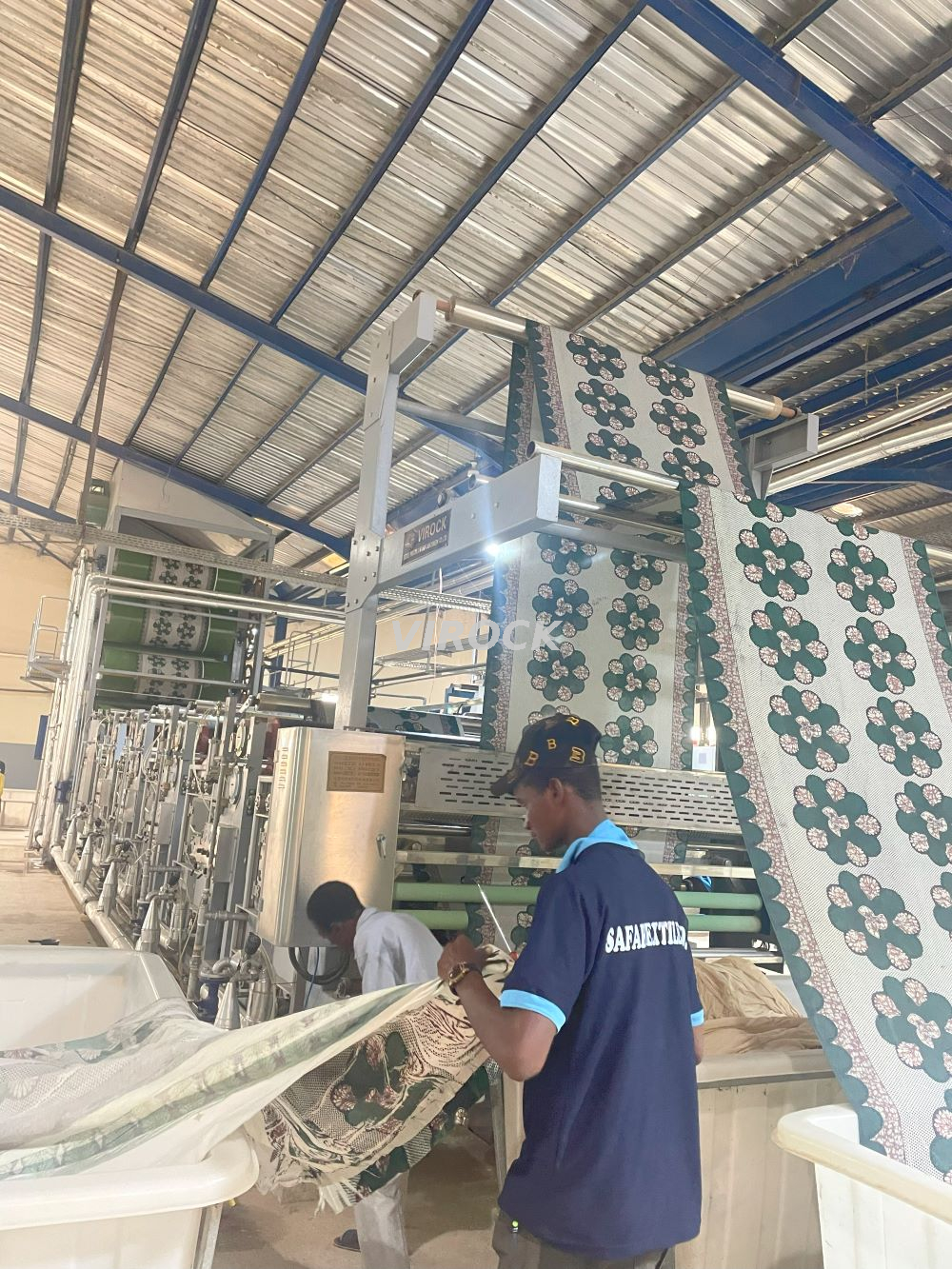
Applying ink onto fabric represents only half the battle. Post-processing permanently sets the color, achieves the desired physical texture, and prepares the material for final cutting. A rigorous evaluation of this stage ensures your products survive repeated consumer washing.
The drying and curing chambers must deliver exceptional thermal efficiency. Compare the temperature uniformity across the entire width of the drying belts. Inconsistent heat distribution causes uneven color fixation. The edges might cure perfectly while the center remains under-processed. Look for multi-zone heating chambers. They allow operators to profile the temperature curve accurately, slowly ramping up heat to prevent fabric scorching.
Modern textile production requires highly efficient fluid management. Evaluate the internal water recirculation capabilities of the proposed printing dyeing equipment. Traditional washing boxes consume massive volumes of fresh water. Advanced systems utilize counter-flow washing technologies. They reuse water from the cleanest final rinse stages, passing it backward to the initial, heavily soiled washing stages. This dramatically reduces total freshwater intake and minimizes wastewater discharge.
Your buyers care deeply about the physical properties of the finished textile. Look closely at the post-finishing equipment and its ability to deliver a consistent hand-feel. Consider the following output metrics:
Shrinkage Control: Stentering frames must apply the exact mechanical tension required to pre-shrink the fabric. This ensures garments hold their shape after retail purchase.
Color Fastness: Proper fixation chambers guarantee the dyes bond at a molecular level, preventing color bleeding during domestic laundry cycles.
Chemical Application: Pad-mangles should apply softening agents uniformly without leaving chemical streaks or residues on the fabric surface.
Manual inspection slows down production and allows subtle errors to slip through. Check the line for inline automated optical inspection (AOI) systems. High-speed cameras scan the moving fabric for misprints, ink spots, and structural weaving flaws. These systems flag errors instantly, allowing operators to halt the machine before hundreds of meters of fabric are ruined.
Many buyers place AOI systems only at the very end of the finishing line. You should ensure optical sensors are also placed immediately after the printing stage. Catching a misaligned screen early saves you from unnecessarily washing, drying, and stentering defective fabric.
The environmental footprint of your facility hinges entirely on your equipment selection. Strict global regulations demand that manufacturers adopt cleaner, more efficient operational models. You must evaluate the long-term utility demands and compliance capabilities of the complete system.
A massive portion of your environmental impact comes from the utility demands of your post-processing stages. You need to compare the specific steam and electricity consumption per kilogram of processed fabric. Do not accept vague efficiency claims; demand concrete consumption data based on your specific fabric types.
Evaluate the heat recovery systems integrated into the equipment. Exhaust air from the drying chambers carries immense thermal energy. High-quality systems capture this hot exhaust and use it to pre-heat incoming fresh air or incoming wash water. Similarly, advanced wastewater heat exchangers pull thermal energy from the hot, dirty effluent leaving the washing boxes. Recycling this thermal energy dramatically lowers the burden on your facility's boilers.
Modern retail brands refuse to partner with non-compliant textile producers. You must verify that the equipment's output capabilities align with strict environmental frameworks. Ask vendors how their machinery supports compliance with ZDHC (Zero Discharge of Hazardous Chemicals) guidelines. The equipment must manage chemical dosing accurately to prevent toxic overflow.
Additionally, the machinery should enable you to achieve OEKO-TEX certifications consistently. By maintaining tight control over curing temperatures and washing efficiency, the system ensures no harmful chemical residues remain on the final fabric. Choosing machines engineered for low liquor ratios and closed-loop water systems directly supports these critical sustainability goals.
Procuring a massive industrial line requires intense collaboration with the manufacturer. The physical installation and subsequent operational ramp-up present significant hurdles. Strong vendor support dictates how quickly you achieve maximum production capacity.
Never assume "plug-and-play" functionality for a complex, synchronized setup. You must demand clear, legally binding protocols for Site Acceptance Testing (SAT). While the vendor might perform a Factory Acceptance Test (FAT) at their own facility, the real proof happens on your factory floor.
During the SAT, run your most difficult fabric blends at maximum speed. Check for communication failures between the printing PLCs and the finishing HMIs. Ensure the vendor remains on-site until the entire line runs flawlessly for an agreed-upon continuous duration, usually 48 to 72 hours.
Compare the depth of vendor-provided training programs. Complex integrated lines require a highly specialized workforce. Operators cannot merely push buttons; they must understand both the chemical variables of dye fixation and the mechanical variables of tension control.
Ensure the vendor provides cross-training. Your printing specialists need to understand how ink viscosity impacts the downstream washing boxes. Your finishing operators need to recognize when a fabric wrinkle originates from a misaligned upstream feed roller. Comprehensive training prevents minor daily issues from escalating into major machine failures.
Industrial components inevitably wear out. You must assess the vendor's guaranteed availability for critical spare parts. Identify the lead times for replacement screens, specialized pumps, optical sensors, and heating elements. A machine sitting idle while waiting for a proprietary sensor destroys your production schedule.
Review the Service Level Agreements (SLAs) rigorously. Check the vendor's guaranteed response times for specialized technical support. Determine if they offer remote diagnostic capabilities. Many modern PLCs allow vendor engineers to log into your system remotely, diagnose software faults, and reset parameters without dispatching a technician physically.
Selecting an integrated textile line demands a holistic evaluation approach. You must prioritize vendors who demonstrate proven, seamless integration between their printing components and finishing chambers. Unified control systems and automated tension management remain non-negotiable for high-quality production.
Take proactive steps to safeguard your investment. Always request access to existing reference sites to see the equipment operating in a real-world environment. Demand explicit utility consumption guarantees written into your procurement contracts. Finally, structure your final payments around strict, performance-based FAT and SAT milestones. By enforcing these standards, you ensure your new machinery delivers continuous, efficient, and reliable textile manufacturing.
A: While technically possible, mixing manufacturers introduces severe integration risks. You will likely face API and PLC compatibility issues, making centralized speed synchronization difficult. Furthermore, if fabric defects occur, mixed-vendor setups often lead to warranty complications and finger-pointing between companies.
A: Most facilities see a full return on investment within 3 to 5 years. This timeline is driven by drastically reduced manual labor costs, significantly lower fabric defect rates, and massive savings on energy and water utility consumption through integrated recovery systems.
A: Strict regulations force manufacturers to abandon traditional, water-heavy machinery. Buyers now must choose low-liquor ratio machines and closed-loop water systems. These advanced units recycle wastewater and capture exhaust heat, ensuring your facility complies with stringent global sustainability standards like ZDHC.


