

Views: 0 Author: Site Editor Publish Time: 2026-08-07 Origin: Site


Upgrading print capacity frequently exposes a costly production bottleneck. Faster digital and screen printers mean little if your downstream finishing equipment lags behind. Upgrading print capacity without proportionally scaling the finishing process creates severe production logjams. An undersized line severely limits your overall daily output. Conversely, an oversized setup drains capital, wastes energy, and monopolizes valuable floor space.
Off-the-shelf equipment metrics typically highlight ideal conditions, masking operational realities. You must base real-world sizing on sustained operational speeds, precise fabric tension controls, specific ink curing times, and strict environmental compliance rules. We provide a concrete framework to help you navigate these challenges. You will learn how to accurately calculate capacity, define rigorous technical specifications, and mitigate risks when integrating new machinery. This guide ensures your next investment perfectly aligns operational capabilities against actual production demands.
Manufacturers often fall into the "maximum speed" trap. They read a printer spec sheet, see a maximum output of 40 meters per minute, and purchase finishing equipment matching that exact speed. This approach consistently leads to undersized finishing lines. You should ignore theoretical maximums. Focus entirely on sustained yield. Printers rarely operate at maximum speed continuously. Finishing equipment must process the sustained daily output without creating backlogs.
The core sizing metric is the dwell time equation. Every chemical process requires a specific time under temperature. We call this dwell time. You calculate the required drying chamber length by multiplying your desired production speed (m/min) by the necessary curing or steaming time (minutes). If your ink requires three minutes to cure and you want to process 10 meters per minute, you need 30 meters of active chamber length.
A basic structural chart helps visualize this relationship between speed, curing time, and equipment footprint.
| Target Operational Speed | Required Curing Time | Minimum Active Chamber Length |
|---|---|---|
| 10 meters/minute | 2 minutes | 20 meters |
| 15 meters/minute | 3 minutes | 45 meters |
| 20 meters/minute | 2.5 minutes | 50 meters |
You must also address physical and spatial limitations. Bottlenecks do not just come from slow drying. They come from physical web length limits. You must differentiate between maximum fabric working width and physical roller width. Always account for batch sizes. Frequent changeovers for small batches drastically reduce actual daily throughput compared to long, continuous runs. Integrating a reliable textile printing finishing line requires balancing these physical constraints against your throughput goals.
Drying and heating zones form the core of any finishing setup. You must evaluate thermal capacity requirements carefully. Different heating sources impact both operational efficiency and facility demands. Gas systems offer rapid heat-up times and high peak temperatures. Electric systems provide cleaner operation but often result in higher monthly utility bills. Thermal oil systems deliver incredibly consistent heat distribution across wide fabric webs, though they require complex plumbing infrastructure.
Tension control dictates the final quality of your print. You must maintain continuous geometric pattern registration. Transitioning materials through various wet and dry zones causes fabrics to stretch or shrink. If you lose tension control, geometric patterns will distort heavily.
To prevent misregistration, modern lines rely on specific components:
Translating technical textile printing finishing line specifications into actual facility floor space requires extreme realism. Spec sheets list machine dimensions, but operational footprints are much larger. You must allocate generous clearances. Operators need safe access for loading and unloading rolls. Maintenance teams need space to pull out internal rollers, clean exhaust ducts, and service drive motors safely.
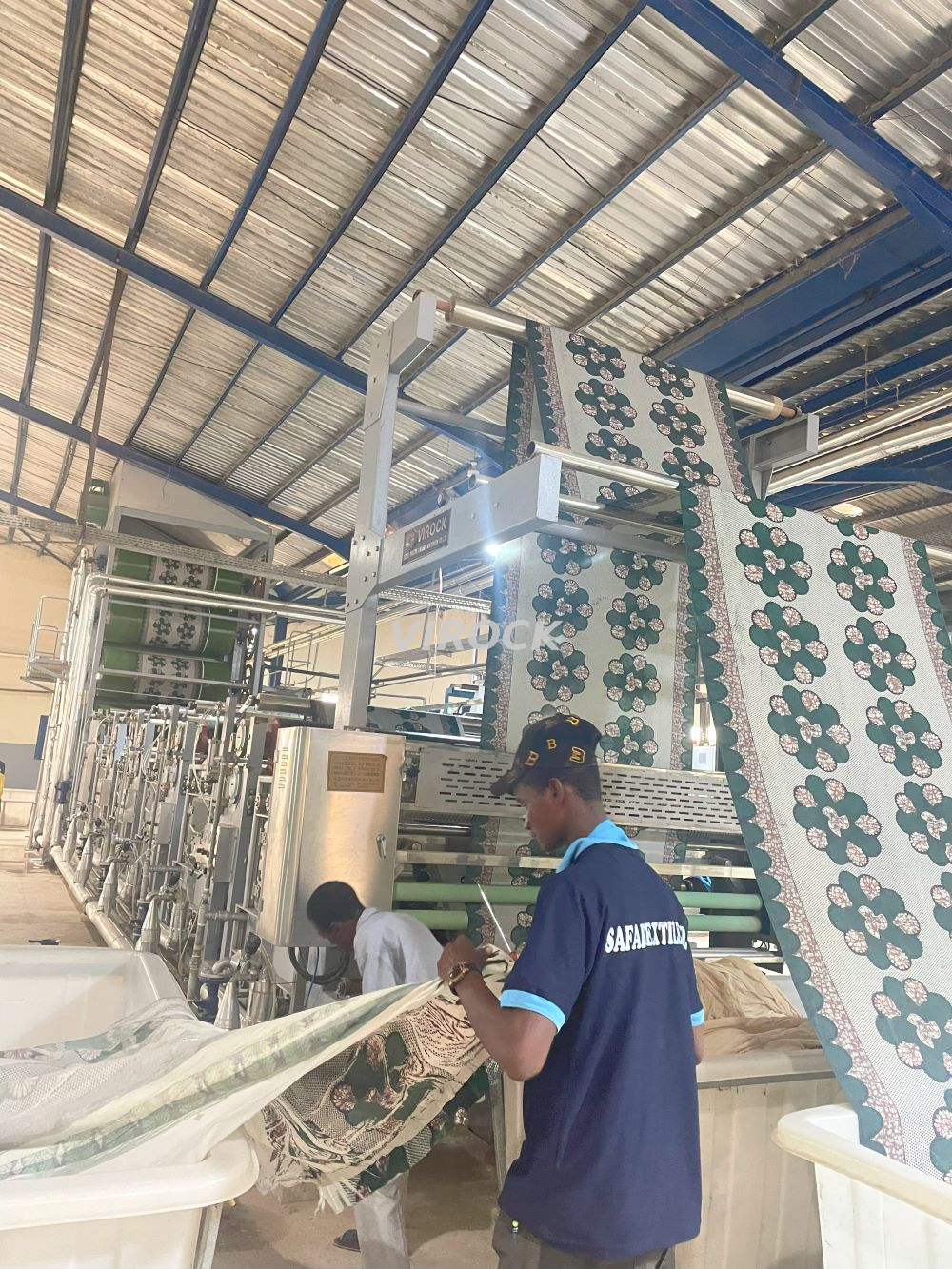
You cannot use a universal finishing setup for all printing methods. You must match the finishing process directly to the ink chemistry. Pigment and sublimation inks are relatively straightforward. They primarily require dry heat. You focus your sizing on polymerizing chambers and calendering units. These processes do not require extensive wet treatments.
Reactive and acid inks present a different challenge. They require complex, multi-stage configurations. After printing, the fabric must pass through a steamer for dye fixation. Following fixation, you need extensive washing ranges to remove unfixed dyes and thickeners. Finally, the fabric requires stenter drying to restore its dimensional stability. This complexity highlights why a custom textile printing finishing line is critical for premium fabric production.
Diverse fabric types also dictate structural differences in your machinery. Sizing a printed fabrics textile printing finishing line for rigid wovens is vastly different than sizing one for high-stretch knits. Woven fabrics are dimensionally stable. You can pull them through standard tension rollers. High-stretch knits will distort under vertical tension. They require advanced overfeed systems and specialized pin chains. Overfeeding pushes slightly more fabric onto the pins than the machine pulls, allowing the knit loops to relax and shrink naturally during drying.
Consider the financial viability of modularity. A modular system allows you to add washing boxes or extra drying chambers as your production scales. Buying a modular frame costs more upfront but prevents the need for an entirely new line when your volume doubles two years later.
Sizing calculations must extend beyond fabric output. You must account for strict regulatory realities. The Environmental Protection Agency (EPA) and local environmental boards enforce strict guidelines on industrial emissions. Pigment curing and fabric drying release Volatile Organic Compounds (VOCs) into the air. Reactive washing generates heavy wastewater streams. Your footprint calculations must include dedicated space for exhaust scrubbers and wastewater filtration units.
Energy consumption is a major operational factor. You must size and install Heat Recovery Systems (HRS) to capture exhaust heat. Stenters and dryers vent massive amounts of hot air. An HRS captures this exhaust energy and uses it to pre-heat incoming fresh air or facility water. Including an HRS increases your initial capital expenditure (CAPEX). However, it drastically lowers your monthly operational expenses (OPEX) by reducing fuel consumption. Over several years, the energy savings heavily outweigh the upfront equipment costs.
Always demand verification. Suppliers often boast about theoretical energy efficiency. Theoretical claims rarely match factory floor realities. You must request verifiable energy consumption data from actual client installations. Ask suppliers to provide kilowatt-hour (kWh) and gas consumption metrics based on fabrics and speeds similar to your planned production.
Scaling up from manual or small-batch production introduces severe operational risks. The primary scale-up chokepoint is physical fabric handling. Small batches allow operators to manually correct alignment issues. Automated, continuous lines run at higher sustained speeds under continuous high tension. If your alignment sensors fail, you can ruin hundreds of meters of fabric before an operator hits the emergency stop.
Utility infrastructure often blindsides expanding businesses. You must assess whether your current facility can handle the sudden spike in utility demands. Commercial-scale finishing lines require massive amounts of industrial water for washing. They demand high-amperage electricity for drive motors and huge volumes of natural gas for thermal chambers. Conduct a facility utility audit before finalizing any equipment sizing. Finding out your gas main is too small after the machinery arrives causes catastrophic delays.
Do not ignore operator capability. Advanced finishing lines are not push-button machines. They require operators who deeply understand thermal dynamics, chemical dwell times, and tension physics. The hidden cost of upgrading is training. If your team cannot interpret a load cell reading or adjust an overfeed parameter, your expensive new line will produce subpar, distorted fabric.
Evaluating the vendor is just as critical as evaluating the hardware. You must look far beyond the basic spec sheet. An impressive brochure means nothing if the vendor cannot support the machine post-installation. A reliable textile printing finishing line supplier acts as an engineering partner, not just a salesperson.
Establish strict evaluation criteria for trust. Look for three specific indicators:
Your next step involves formulating a rigorous Request for Proposal (RFP). Do not just list features. Demand outcome-based guarantees. Specify your required shrinkage tolerances, color fastness targets, and daily yield expectations. Force the supplier to guarantee these outcomes under continuous operational conditions.
Proper finishing line sizing remains a delicate balancing act. You must align chemical dwell times, physical facility constraints, and target daily throughput accurately. Relying solely on printer speed metrics will result in severe processing bottlenecks and wasted resources.
Avoid over-capitalizing on unnecessary modules that do not serve your specific ink chemistry. However, never under-size your primary drying or washing capacities. These core zones strictly govern your maximum output speed and define your final fabric quality.
Before shortlisting vendors or signing purchase orders, conduct a comprehensive facility utility audit. Assess your gas, water, and electrical thresholds. Then, request a custom capacity calculation from a qualified engineering team. This proactive approach ensures your new finishing line delivers profitable, sustained performance.
A: Specify a machine roller width typically 200mm to 300mm wider than your maximum fabric working width. This extra space accommodates edge pinning, fabric tracking variations, and selvedge uncurling without risking edge damage during continuous high-speed processing.
A: Linear print speed differs completely from chemical dwell time. Curing inks requires a specific time-under-temperature to fix properly. This thermal requirement strictly dictates the physical length and operational speed of the finishing line, regardless of how fast the printer lays down ink.
A: While possible through highly custom configurations, it remains highly inefficient. Reactive inks require extensive washing and steaming. Pigment inks require only dry heat. Routing pigment fabrics through a massive reactive line wastes enormous amounts of energy, time, and floor space.


